
Comparison or condensation control approaches
| Criterion | Heater | Desiccant | Drykeeper |
| Power required | Yes | No | No |
| Addresses humidity root cause | No | Partially | Yes |
| Regenerates in operation | N/N | No | Yes |
| Maintenance needed | No | Yes | No |
| Long-term effectiveness | Variable | Limited | Yes |

Sealed CCTV cameras are designed to survive rain, dust, and harsh environments. Yet many still fail from moisture trapped inside the housing. The problem is rarely sealing quality alone. It is physics.
Why Sealed Cameras Still Fog Internally
When a camera housing is closed, it traps the ambient air present at that moment. That air always contains water vapour, even on a dry day.
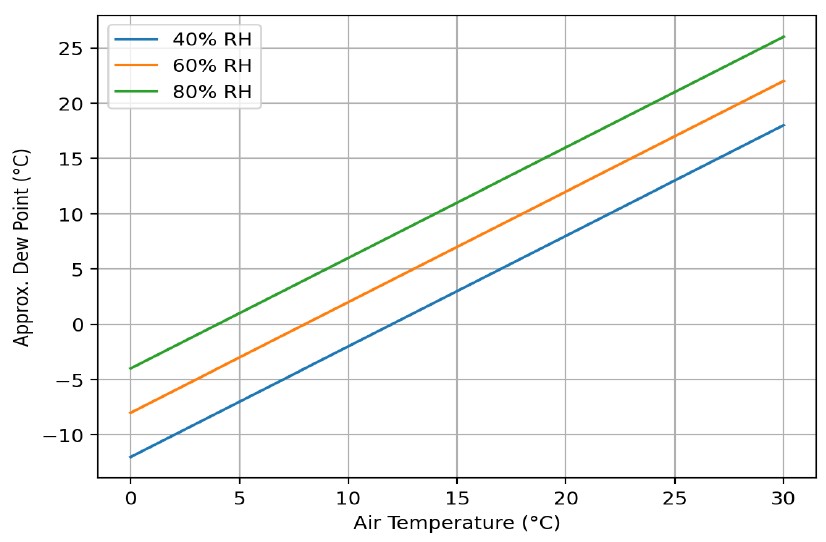
As temperature falls overnight, the air’s capacity to hold moisture decreases. Relative humidity rises until it reaches 100%. At that point, condensation forms on the coldest internal surfaces — typically the lens barrel, optical window, or PCB.
Importantly, the enclosure does not need to leak for this to occur. In a perfectly sealed camera, temperature cycling alone is sufficient to generate repeated condensation events.
This explains why many IP-rated housings still suffer from internal fogging despite meeting ingress protection standards.
Dew Point: The Design Parameter That Matters
Engineers often specify sealing performance, heater wattage, and IP rating. However, the decisive parameter is dew point temperature.
For example:
- Air sealed at 25 °C and 60% RH
- Dew point ≈ 16.7 °C
- A temperature drop of just 8–9 °C triggers condensation
In outdoor CCTV installations, that temperature swing is routine.
Unless internal humidity is controlled, fogging is not a defect. It is an expected thermodynamic outcome.
Why Heaters Only Treat the Symptom
Many OEM designs include low-wattage heaters or window defog elements. These reduce visible fog by raising internal temperature above dew point.
However:
- They do not remove moisture from the enclosure.
- They increase power consumption.
- They add thermal stress to components.
- They complicate low-power or PoE-optimised designs.
Heaters can prevent visible condensation while humidity remains high, accelerating corrosion, leakage currents, and sensor drift.
In Total Cost of Ownership (TCO) terms, they increase energy consumption and component stress without addressing root cause moisture.
Why Traditional Desiccants Are Not a Long-Term OEM Solution
Silica gel is often added during assembly. While effective initially, it behaves as a consumable component.
Over time:
- It saturates.
- Its performance declines.
- It requires replacement or oversizing.
In sealed CCTV cameras mounted at height or in public infrastructure, field replacement is impractical. A consumable element contradicts maintenance-free design objectives.
For OEMs targeting infrastructure, transport, or smart city deployments, service intervention drives lifecycle cost.
Engineering Approach: Lower the Internal Dew Point
A more robust strategy is to stabilise internal relative humidity below condensation threshold rather than intermittently heating the air.
This requires:
- Moisture uptake when RH rises.
- Controlled release when temperature increases.
- Long-term stability without regeneration cycles.
Humidity buffering systems such as Drykeeper are designed around this principle. They act as passive humidity regulators rather than one-time desiccants.
When internal RH attempts to rise above approximately 50–60%, the hygroscopic matrix absorbs vapour. When temperature increases, it releases moisture gradually, maintaining equilibrium.
The result is a lowered dew point and prevention of condensation cycles.
Design Integration in CCTV Optical Housings
For OEM integration, placement considerations include:
- Free air circulation within the housing
- Avoiding oil or contamination contact
- Positioning away from direct lens obstruction
Because the system is passive, it:
- Draws no electrical power
- Generates no heat
- Requires no control circuitry
This aligns well with PoE-optimised cameras and low-power edge devices.
For compact housings, thin-profile solutions minimise volume impact while maintaining adequate buffering capacity.
Total Cost of Ownership Logic for OEMs
From an OEM perspective, condensation control influences:
- Warranty claims
- Image degradation returns
- Field service dispatches
- Brand reliability perception
A passive humidity control strategy reduces hidden lifecycle costs by preventing corrosion and intermittent optical faults.
For public infrastructure tenders, demonstrating maintenance-free internal humidity control can also support long-term reliability specifications.
When Is This Approach Most Relevant?
Condensation control becomes critical when:
- Cameras operate outdoors with daily temperature cycling
- Installations are remote or high-mounted
- Optics are sensitive to fogging (e.g., high-resolution imaging)
- Power budget is tightly managed
In these scenarios, humidity stabilisation complements sealing and heating strategies rather than replacing them.
Technical Call to Action
If you are designing sealed CCTV or optical enclosures and want to evaluate internal dew point stability, we can support:
- RH and dew point modelling
- Volume-based sizing guidance
- Integration recommendations for compact housings
Contact us for engineering support or request evaluation samples for prototype testing.