
DRYKEEPER
Introduction to Drykeeper Condensation Control
What is Drykeeper
Drykeeper is a maintenance-free way to stop condensation forming inside sealed enclosures — with no power, no fans, and nothing to replace.
It’s a thin (3mm) sheet made from synthetic rubber blended with a super absorbent polymer, wrapped in non-woven fabric. It can be supplied cut-to-size or as sheet stock for cutting to shape.
Typical applications:
- Electrical control and distribution panels
- Emergency roadside telephones
- Remote monitoring systems
- Surveillance, CCTV, and ANPR cameras
- Traffic signals and displays
- Marine electronics
- Energy storage and power conversion systems (PCS)
- EV charging stations
Unlike silica gel, which saturates and needs replacing or regenerating, Drykeeper keeps working for years without any intervention.
The problem it solves, in plain terms
Think of a sealed enclosure like a flask with a fixed amount of moist air trapped inside. That amount of moisture doesn’t change just because the temperature changes, but where that moisture sits does change.
- When it’s warm, the air can hold that moisture as invisible vapour.
- When it cools down — overnight, in transport, or when equipment is powered off — the same air can no longer hold as much moisture. The excess has to go somewhere. It condenses as liquid water on the coldest surfaces inside: PCBs, metal housings, lenses, connectors.
This is why an enclosure can look “fine” on a humidity gauge during the day, yet still get condensation-related failures overnight or after a cold journey. The moisture was always there — it just changes from vapour to liquid as things cool.
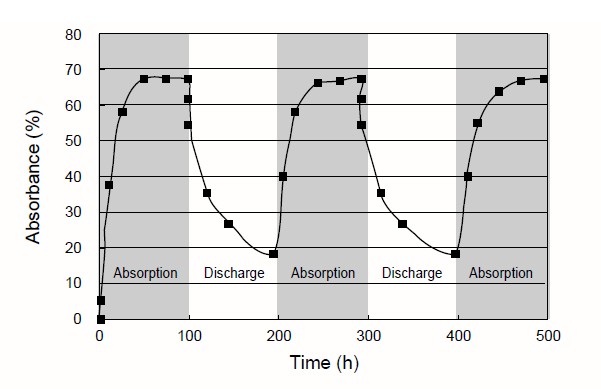
Drykeeper works like a buffer, not a dryer. Picture a sponge that breathes with the seasons:
- As the enclosure cools and humidity rises, Drykeeper pulls moisture out of the air and holds it.
- As the enclosure warms again, it releases that moisture back into the air.
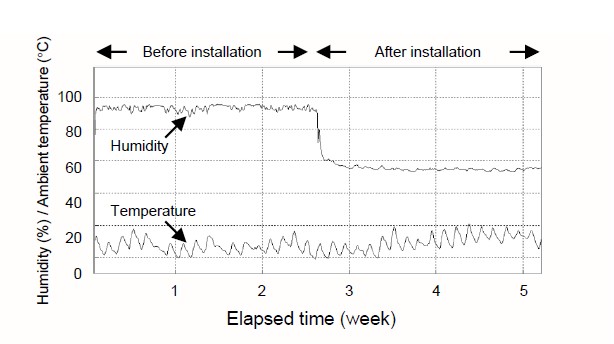
Nothing is added or removed from the enclosure overall — the moisture just gets parked safely inside the sheet instead of condensing on your components. Because there’s no drying-out or saturation point in normal use, there’s nothing to maintain and nothing that wears out. It typically holds the internal environment at a stable 50–60% RH.
.
Why relative humidity (RH) alone doesn’t tell the whole story
Most people size a condensation-prevention solution around a relative humidity number. That’s understandable — RH is what’s easy to measure and quote. But RH is temperature-dependent: the same amount of moisture in the air will read as a low %RH when warm and a high %RH when cool, purely because warm air can hold more moisture before it’s “full.”
What actually decides whether condensation forms is the dew point — the temperature at which the air is holding all the moisture it can, and any further cooling forces water out as liquid.
So the real design question isn’t “what’s the RH?” — it’s “how does the dew point compare to my coldest internal surface temperature, across everything this enclosure will experience?” If the surface temperature ever drops below the dew point, you get condensation, regardless of what the RH gauge said an hour earlier.
Worked example — how dew point shifts with temperature and RH:
| Air Temperature | Relative Humidity | Dew Point |
| 20 °C | 80% | 16.4 °C |
| 30 °C | 60% | 20.3 °C |
| 40 °C | 50% | 28.3 °C |
| 70 °C | 30% | 44.7 °C |
This is also why Drykeeper is sized around the enclosure’s actual trapped moisture load (its absolute humidity), not an arbitrary RH target — the goal is to keep the dew point safely below the coldest surface the enclosure will see, not to chase a number on a gauge.
How do I select the right Drykeeper for my application?
Standard sizes:
| Description | Dimensions (mm) | Sheet capacity (g) | Nominal Volume (L) |
| Drykeeper A4 | 210 x 300 x 3 | 32 | 300 |
| Drykeeper A5 | 150 x 210 x 3 | 16 | 150 |
| Drykeeper BC | 60 x 100 x 3 | 2.6 | 24 |
| Drykeeper Mini | 15 x 15 x 3 | 0.12 | 0.5 |
| Drykeeper Sheet | 600 x 630 x 3 | 116 | 1000 |
Custom selection tool: we provide a downloadable Excel worksheet (no macros or VBA) that calculates the right Drykeeper configuration for your enclosure — from CCTV housings to outdoor distribution panels. It only needs four inputs.