
DRYKEEPER
Introduction to Drykeeper Condensation Control
What is Drykeeper
Drykeeper is a maintenance-free product for controlling condensation in sealed enclosures without using power. It uses a halogen-free and environmentally friendly moisture absorbing sheet made by blending synthetic rubber with a super absorbent polymer. It is 3mm thick and available in a range of sizes wrapped in non-woven fabric or can be cut-to shape as needed. Moreover, it is highly absorbent occupies little space, and is extremely easy to handle.
Popular applications include:
– Electrical control and distribution panels
– Emergency roadside telephones
– Remote monitoring systems
– Survielence, CCTV and ANPR cameras
– Traffic signals and displays
– Marine electronics
– Energy storage and power conversion systems (PCS)
– EV charging stations
When comparing Drykeeper to silica gel it is important to note that Drykeeper takes a different approach to cabinet humidity control to reduce condensation. Unlike silica gel which becomes saturated and requires replacing/regeneration, it lasts for years
How does Drykeeper work
Drykeeper operates as a passive humidity buffer rather than an active dehumidifier. When the temperature falls, relative humidity inside the cabinet rises and Drykeeper absorbs water vapour from the air. When the temperature increases, the relative humidity falls and it releases that moisture back into the enclosure. This reversible process keeps the internal environment stable and avoids the formation of liquid water.
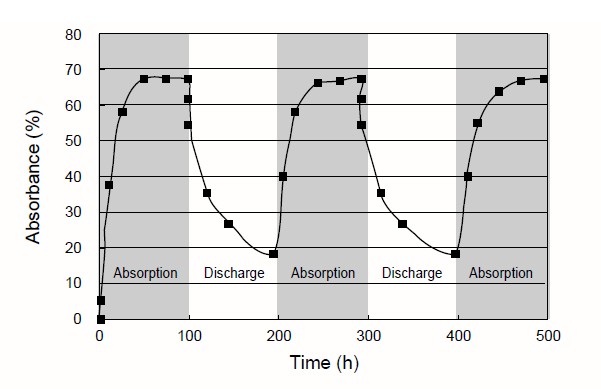
Fig. 1 Drykeeper moisture absorbing and discharging characteristics
Because Drykeeper does not expel moisture from the enclosure, the system remains balanced and self-regulating. There are no fans, heaters, power supplies, or control electronics, and no dependency on external conditions.
Drykeeper provides long term maintenance free humidity control. It stabilises internal humidity at approximately 50 to 60% RH preventing condensation even during temperature falls. Dry keeper is well suited for applications where access to routine maintenance is difficult offering a maintenance free alternative to silica gel.
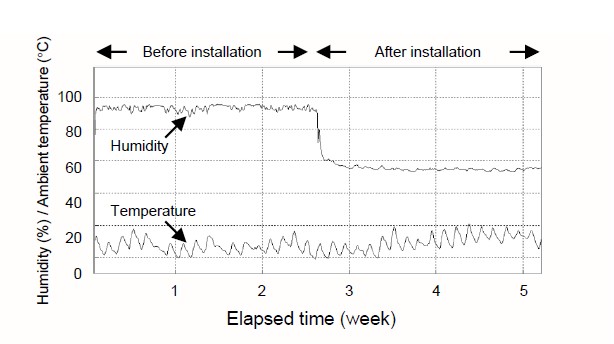
Fig. 2 Transition of cabinet humidity after installing Drykeeper
Why is Drykeeper different?
Many users focus on relative humidity (RH) alone. While RH is easy to measure and reference, it is the dew point that governs condensation. Dew point is the temperature at which water vapour present in the air begins to condense on internal surfaces. This distinction is critical when selecting a condensation-prevention solution.
Relative humidity depends on temperature. As air warms, its capacity to hold moisture increases and RH falls. As air cools, RH rises. Yet, absolute humidity is the actual mass of water vapour present in the air, usually expressed in grams per cubic metre (g/m³), and remains constant. Determination of the dew point is by from the absolute humidity, not by relative humidity alone.
Condensation behaviour inside sealed enclosures
On sealing an enclosure,, it traps the water ( absolute humidity) inside. The total mass of trapped water vapour does not change because temperature changes. What changes is the state of that moisture, i.e. whether it remains as vapour or condenses into liquid water.
As temperature falls, relative humidity increases. When the air temperature reaches the dew point, RH is 100% and condensation begins to form on the coldest internal surfaces. These can be optical elements, metal components, housings, and printed circuit boards (PCBs) and more.
This explains why condensation can occur even when measured RH appears “moderate” during operation. Enclosures that run warm in service may cool during power-down, night-time exposure, or transport. Air unsaturated air at operating temperature can still contain enough moisture to reach saturation when cooled.
The table below illustrates how dew point varies with temperature and relative humidity under typical enclosure conditions:
| Air Temperature | Relative Humidity | Dew Point |
| 20 °C | 80% | 16.4 °C |
| 30 °C | 60% | 20.3 °C |
| 40 °C | 50% | 28.3 °C |
| 70 °C | 30% | 44.7 °C |
Dew point control: key to reducing condensation in enclosures
The most reliable way to prevent condensation is not to chase arbitrary relative humidity targets. It is to ensure that the dew point remains below the coldest internal surface temperature under all expected conditions. This is what Drykeeper does.
By calculating the absolute humidity inside the enclosure, Drykeeper selection establishes the number if sheets needed to protect it from condensation.
This relationship highlights an important principle. Condensation prevention is about controlling humidity behaviour over time. It is not about the indiscriminate removal of moisture.
How do I select Drykeeper for my application
General selection information
| Description | Dimensions (mm) | Sheet capacity (grams) | Nominal Volume (Litres) |
|---|---|---|---|
| Drykeeper A4 | 210 x 300 x 3 | 32 | 300 |
| Drykeeper A5 | 150 x 210 x 3 | 16 | 150 |
| Drykeeper BC | 60 x 100 x 3 | 2.6 | 24 |
| Drykeeper Mini | 15 x 15 x 3 | 0.12 | 0.5 |
| Drykeeper Sheet | 600 x 630 x 3 | 116 | 1000 |
Custom Selection Tool
We have a downloadable Drykeeper selection tool that uses an Excal worksheet containing no macros or VBA code. Here you will find how to select Drykeeper condensation protection products for a range of products from CCTV cameras to outdoor electrical distribution panels. It only needs you to enter four pieces of informationneeds only that requires only four pieces of information.