
Drykeeper:
A Maintenance-Free Approach to Cabinet Condensation Prevention
Condensation prevention in sealed enclosures
Prevent Condensation by Lowering the Dew Point — Not by Chasing Relative Humidity
Condensation inside sealed cabinets and enclosures is one of the most common and most underestimated causes of long-term reliability problems in electronic, optical, and electrical equipment. Even very small amounts of moisture can lead to corrosion, leakage currents, sensor drift, or intermittent faults that are difficult to diagnose once equipment is installed.
The challenge is often compounded in outdoor or remote installations, where enclosures operate in hostile environments and access for servicing is limited. Drykeeper is designed specifically to address this problem. Because it requires no electrical power, it is well suited to applications such as traffic signs, outdoor instrumentation, and remote monitoring stations that rely on batteries and photovoltaic power boxes.
Rather than actively removing moisture or relying on consumable desiccants, Drykeeper prevents condensation by stabilising humidity inside sealed and unventilated enclosures, providing long-term protection without servicing or maintenance.
This article explains how condensation forms, why traditional approaches often fall short, and how Drykeeper offers a practical, maintenance-free alternative.
Understanding Dew Point, RelativeHumidity and Condensation in Sealed Enclosures
Condensation inside sealed enclosures is often misunderstood. Many users focus on relative humidity (RH) alone, but condensation is actually governed by the dew point — the temperature at which water vapour in the air begins to condense on surfaces.
At a fixed moisture content (absolute humidity), cooling the air increases relative humidity. When the air temperature falls to the dew point, condensation forms on the coldest internal surfaces, such as lenses, metal components, and printed circuit boards (PCBs).
Relative vs Absolute Humidity And Why RH Can Be Misleading
- Relative humidity depends on temperature and changes as air warms or cools
- Absolute humidity is the actual mass of water vapour present in the air
- Dew point depends on absolute humidity, not relative humidity
This is why condensation can occur even when RH appears “moderate”, particularly in warm enclosures that later cool during power-down, night-time operation, or transport.
Typical Dew Points in Enclosures
The table below illustrates how dew point varies with temperature and relative humidity under common enclosure conditions:
|
Air Temperature |
Relative Humidity |
Dew Point |
|
20 °C |
80% |
16.4 °C |
|
30 °C |
60% |
20.3 °C |
|
40 °C |
50% |
28.3 °C |
|
70 °C |
30% |
44.7 °C |
If any internal surface cools below these temperatures, condensation will form.
Why Lowering the Dew Point Prevents Condensation
What ultimately matters is not how much water is present in total, but whether relative humidity reaches 100% at any point during operation or environmental cycling. The most reliable way to prevent condensation is therefore not to chase relative humidity targets, but to lower the dew point below the coldest internal surface temperature.
Drykeeper achieves this by reducing absolute humidity inside the enclosure. As absolute humidity falls, the dew point shifts downward, preventing condensation even as temperatures drop.
Only a few hundredths of a gram of water vapour are enough to cause condensation-related reliability problems in compact enclosures.
Full dew-point and absolute-humidity tables, including high-temperature and rapid cool-down scenarios, are available in the Drykeeper technical white paper.
Relative Humidity, Temperature, and Dew Point
Relative humidity is temperature dependent. As temperature falls, the air’s capacity to hold moisture decreases, causing RH to rise even if no additional moisture is introduced.
In a sealed enclosure this means:
- air that is unsaturated during operation may still contain significant moisture
- temperature drops (night-time cooling, power-off, transport) can rapidly push RH to 100%
- condensation forms on the coldest internal surfaces
Preventing condensation therefore requires controlling humidity behaviour, not simply absorbing moisture indiscriminately.
Condensation Prevention vs Moisture Removal
Many humidity-control methods focus on removing as much moisture as possible. While this can be effective in some applications, it is not always necessary — or practical — in sealed cabinets.
Condensation only occurs when RH reaches 100%. If humidity is kept safely below this threshold, condensation cannot form within the normal operating temperature range.
Drykeeper is designed around this principle. Instead of attempting to dry the enclosure to extremely low humidity levels, it maintains humidity in a stable, controlled range of approximately 50–60% RH, safely below the condensation point.
How Drykeeper Works
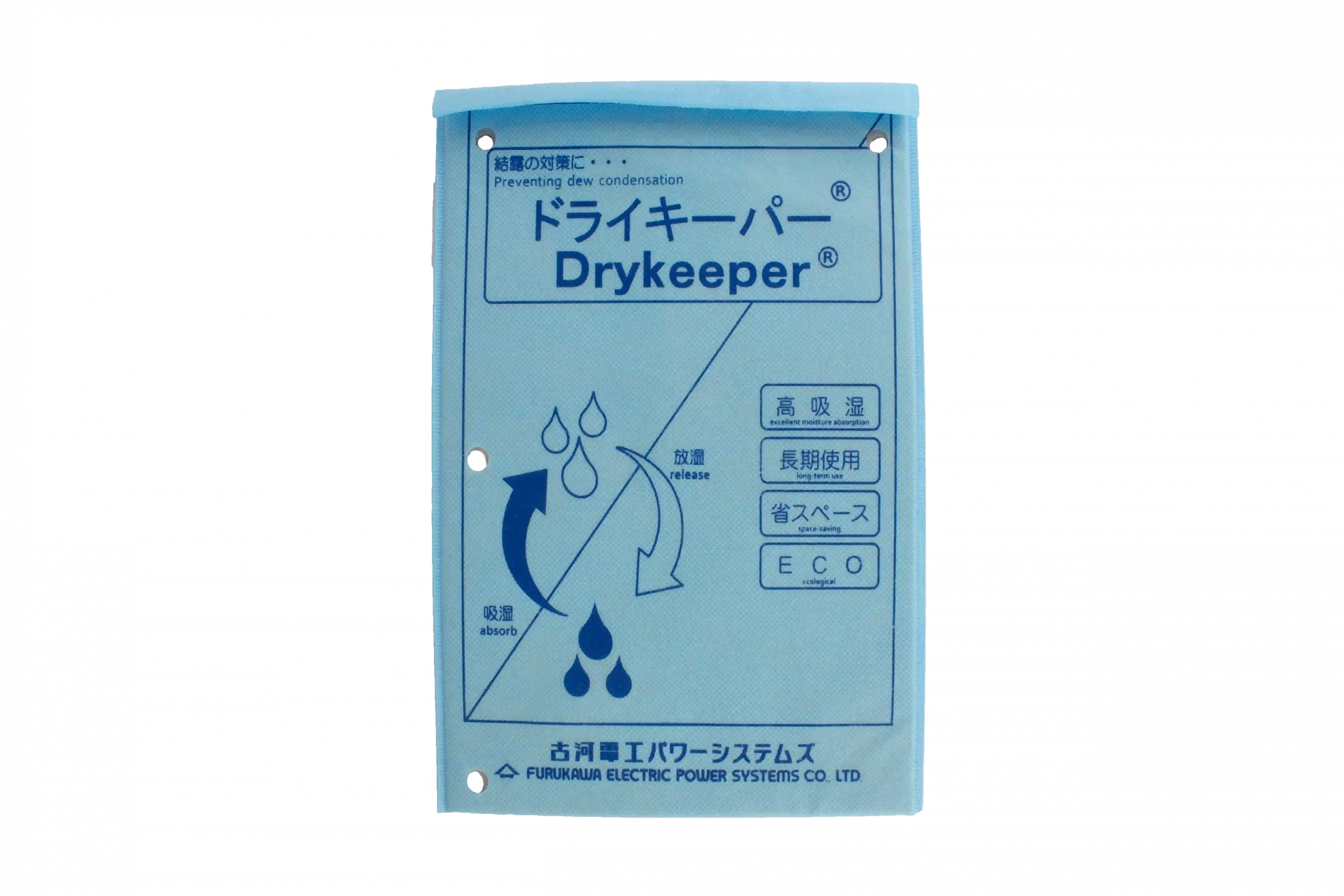
Drykeeper functions as a passive humidity buffer.
When relative humidity inside the enclosure rises, Drykeeper absorbs water vapour from the air. When humidity later falls — typically as temperature increases — it releases moisture back into the enclosure. This reversible process smooths out humidity fluctuations and prevents the sharp RH spikes that lead to condensation.
Key characteristics include:
- no liquid water generation
- no electrical power required
- no fans, heaters, or control electronics
- no consumable materials
Because the process is self-regulating, Drykeeper operates effectively over a typical service life of up to 10 years, without maintenance or replacement.
How Drykeeper Differs from Silica Gel and Conventional Desiccants
Silica gel and similar desiccants absorb moisture until they become saturated. Once full, they no longer provide protection unless replaced or regenerated. In enclosures exposed to temperature cycling, saturation can occur faster than expected — often without any visible warning.
Drykeeper works differently:
- it is not consumed during operation
- it does not “fill up” under normal enclosure conditions
- it remains effective across repeated temperature cycles
This makes Drykeeper particularly suitable where access for servicing is limited or where long-term unattended operation is required.
Where Drykeeper Is Most Effective
Drykeeper is well suited to applications where:
- enclosures are sealed or unventilated
- temperature cycling is unavoidable
- condensation prevention is more important than ultra-low humidity
- maintenance-free operation is required
- long service life is expected
Typical applications include electrical cabinets, electronic control enclosures, optical housings, laboratory equipment, outdoor instrumentation, railway signalling, emergency phones, PV connection boxes, wind-turbine control panels, and storage cabinets for sensitive components.
Where extremely low humidity levels or active moisture removal are required, other technologies may be more appropriate. Drykeeper is not intended to replace all dehumidification methods — but to solve a specific, widespread condensation problem efficiently and reliably.
Long-Term Reliability Through Stability
Condensation damage is rarely dramatic. Instead, it appears gradually as corrosion, intermittent faults, unexplained drift, or premature component failure. By preventing relative humidity from ever reaching the dew point, Drykeeper addresses the root cause rather than the symptoms.
For designers and operators seeking maintenance-free cabinet condensation prevention, Drykeeper offers a simple, robust solution aligned with modern expectations for long-life equipment.
Drykeeper is available in sheet form in a range of sizes for enclosures from under one litre to several cubic metres.
Appendix 1
Absolute Humidity Table (g/m³)
| Air Temp (°C) | 90% RH | 80% RH | 70% RH | 60% RH | 50% RH | 40% RH | 30% RH | 20% RH |
| 40 | 46.0 | 40.9 | 35.8 | 30.6 | 25.5 | 20.4 | 15.3 | 10.2 |
| 35 | 35.9 | 31.9 | 27.9 | 23.9 | 19.9 | 15.9 | 12.0 | 8.0 |
| 30 | 30.3 | 26.9 | 23.6 | 20.2 | 16.9 | 13.5 | 10.1 | 6.7 |
| 25 | 23.0 | 20.4 | 17.9 | 15.3 | 12.8 | 10.2 | 7.7 | 5.1 |
| 20 | 15.6 | 13.9 | 12.2 | 10.4 | 8.7 | 7.0 | 5.2 | 3.5 |
| 15 | 11.5 | 10.2 | 8.9 | 7.7 | 6.4 | 5.1 | 3.8 | 2.6 |
| 10 | 8.5 | 7.6 | 6.6 | 5.7 | 4.7 | 3.8 | 2.8 | 1.9 |
(Rounded to 0.1 g/m³)
Drykeeper is suitable for a wide range condensation control applications including those without power.

Typical Drykeeper applications include:
electrical cabinets
electronic control enclosures
outdoor instrumentation
wind turbine control panels
railway signalling
emergency phones
PV connection boxes
remote monitoring stations
optical housings
laboratory equipment
storage cabinets for sensitive components
clothes/shoe storage
Drykeeper Resources
Feature and benefits of Drykeeper (current page)
Blog post-Drykeeper Vs Silica gel/desiccants
White paper (under development)