
Combining Ionic Membrane Dehumidification with Silica Gel Desiccants
Read the full open-access paper
Explore the experimental data and spectroscopic results behind this maintenance-free humidity control approach.
Source: Open-access peer-reviewed study
Combined Ionic Membrane and Silica Desiccant Configuration for Maintenance-Free Humidity Control in Equipment
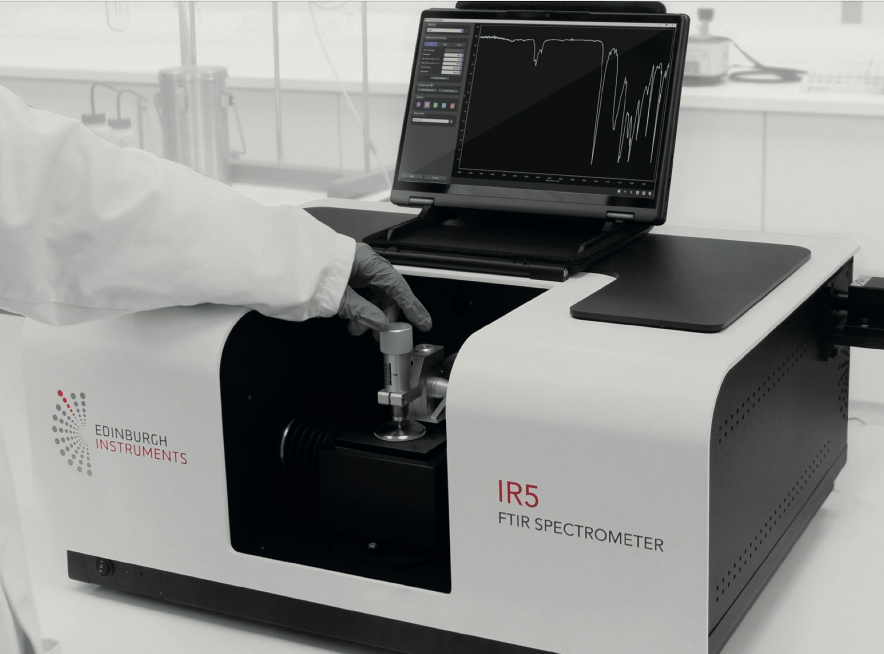
Edinburgh Instruments FTIR-IR5
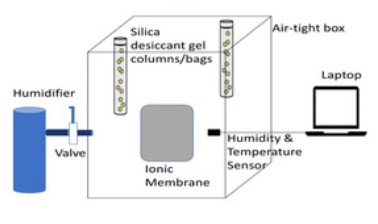
Schematic setup of the humidity experiments in airtight boxes.
Many scientific instruments operate with hygroscopic optical components that are sensitive to moisture. Humidity control in infrared spectrometers, optical parametric oscillators (OPOs), and laser systems rely on materials such as potassium bromide (KBr), which soon degrade in humid environments. Even moderate water vapour levels can also introduce noise and measurement errors, particularly in mid-infrared spectroscopy.
Humidity control in this type of equipment has relied on nitrogen purging or replaceable silica gel desiccants. While effective, both approaches introduce ongoing maintenance, operating costs, or logistical complexity. Nitrogen purging requires infrastructure and continuous supply. Moreover, silica gel needs monitoring and either replacement or regenerated once saturated.
This open-access study investigates an alternative, maintenance-free approach. It combines an ionic membrane dehumidifier with silica gel desiccant inside sealed instrument enclosures. Ionic membranes actively remove water vapour through an electrochemical process without noise or vibration. It also benefits from a compact form factor suitable for precision equipment.
The results show that the combined membrane–desiccant configuration outperforms either technology used alone. In controlled tests, relative humidity reduced from 73% to 15% within 20 hours in a 70L enclosure, and from 80% to 20% within 40 hours in a 230L enclosure. Importantly, the combined system sustained humidity reduction even during temperature fluctuations.
Using ionic membrane dehumidifiers with silica gel
A key finding is that the ionic membrane removes moisture from the air and regenerates the silica gel in situ. Desiccant beads that had absorbed significant moisture returned close to their dry condition within days of operation alongside the membrane. This eliminates routine desiccant replacement and enables long-term, reusable humidity control.
The study also demonstrates a direct performance benefit for optical instrumentation. Measurements taken from a commercial FTIR spectrometer showed that water vapour absorption lines in the mid-infrared region fell as internal humidity dropped from 42.5% to 15.1% within 90 minutes. Low-to-moderate absorption lines almost disappeared, reducing spectral interference and improving measurement clarity.
Overall, this work validates a robust, low-maintenance humidity control strategy for sealed scientific equipment. The combined ionic membrane and silica gel approach provides redundancy during power interruptions. Moreover, it protects sensitive optics during transport and offers a practical route to long-term moisture management without servicing. For manufacturers and users of precision instruments, it represents a compelling alternative to traditional purging or consumable-based solutions.